
Hastings City
WestSide
The businesses are gone. The names are still in the plasterwork. Eight buildings. Eight stories. You've walked past all of them.
There is a street in Hastings where the buildings remember the names of everyone who has ever traded in them. Not plaques. Not signs. The actual names of businesses and buildings, cast into the plasterwork of the upper facades... above the verandah line, above eye level, above the reach of any shopfitter or signwriter who came after.
Heretaunga Street West was flattened by an earthquake in 1931. Rebuilt almost entirely in two years. And the people who rebuilt it wrote their names into the concrete like they expected to be permanent.
Most of them weren't. The names are.
"The building remembers what it was while whoever is inside trades as something else entirely."
There are at least eleven confirmed ghost letters on WestSide right now. Some cut deep and clean. Others are fading... partly painted over, barely there if the light is flat. All of them readable if you know where to look. This is where to look.
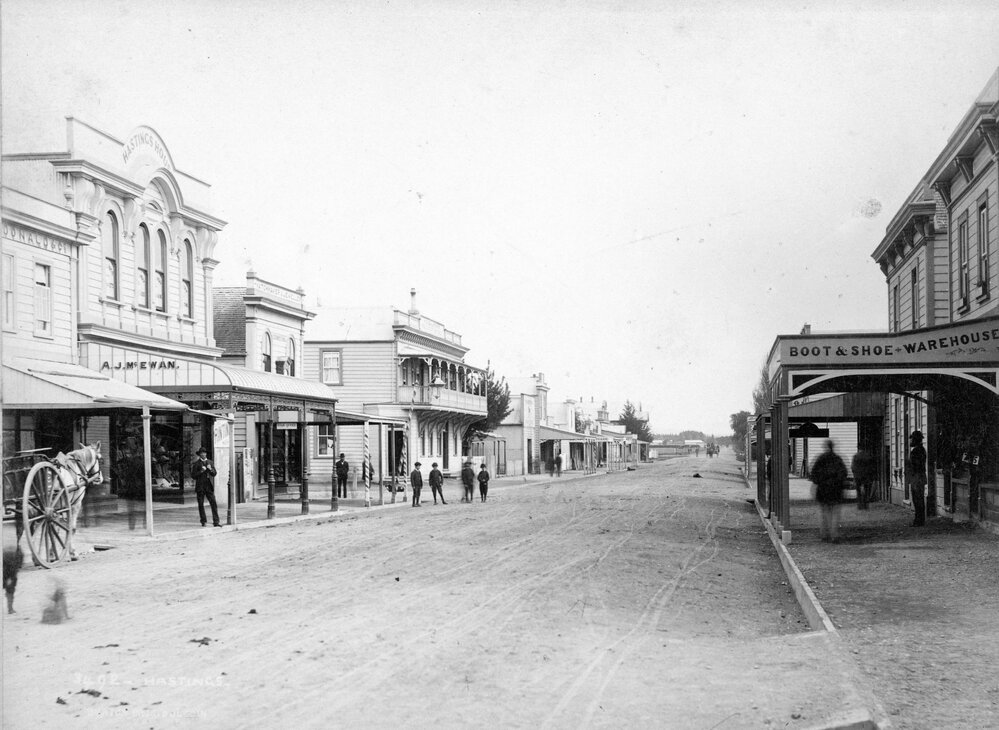
Heretaunga Street West, c.1895 · Hastings War Memorial Library · CC BY-NC-ND 4.0 · hastings.recollect.co.nz/nodes/view/9935
Start at the railway end. Walk west. Stay on the footpath and look up above the verandah line. Eight buildings. Ninety-plus years. Every name still there.
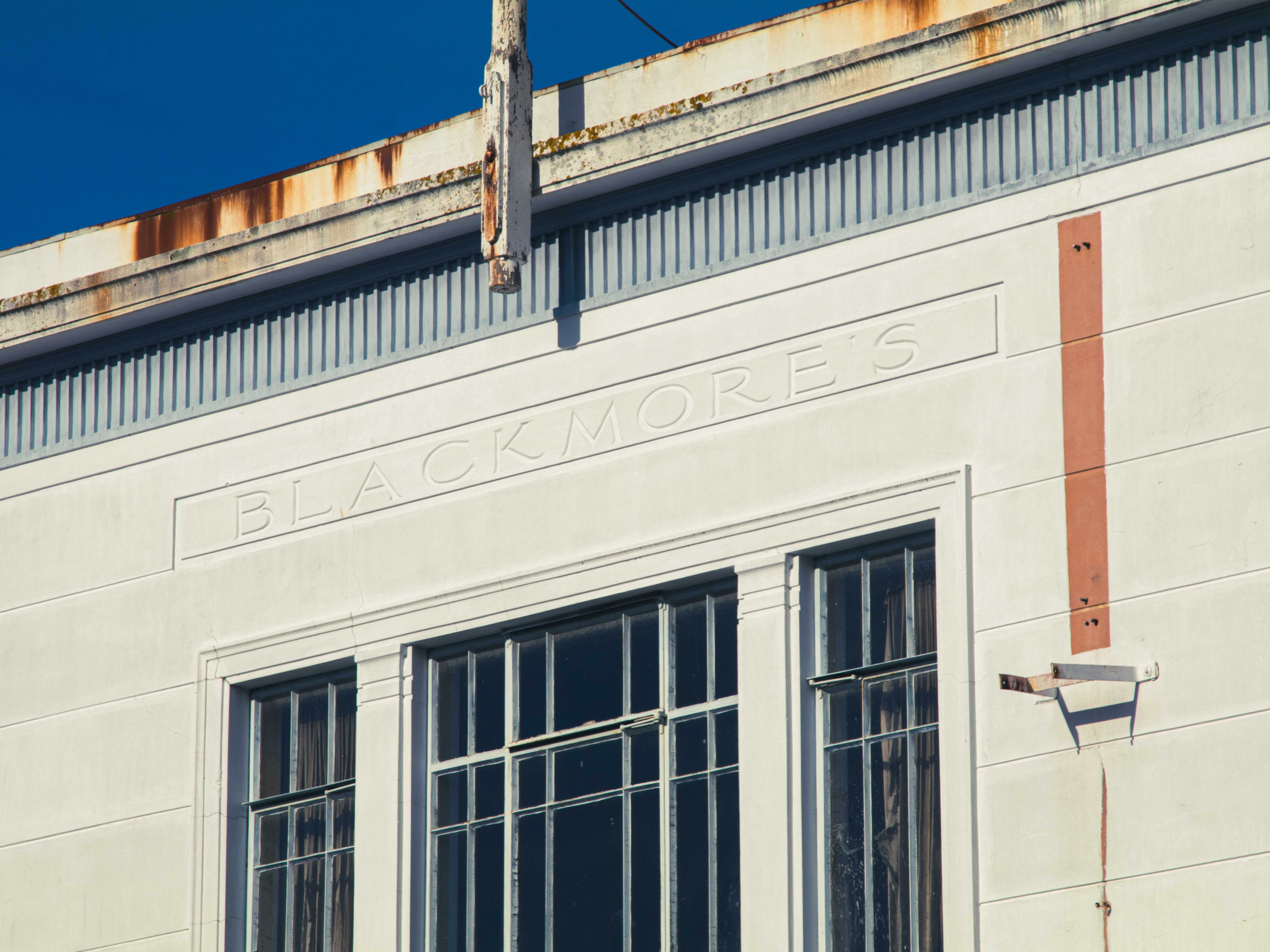
Left bay of the Heretaunga Buildings facade, above the verandah. Blackmore's were men's outfitters who stayed long enough that when Davies and Phillips rebuilt the block in 1935, their name went into the concrete. Complete. Still readable. Shift your eyes to the right bay and look harder... "H J GRIEVE" is still there too, a jeweller who also had a branch further down the strip. Mostly erased now. But there if the light is right.
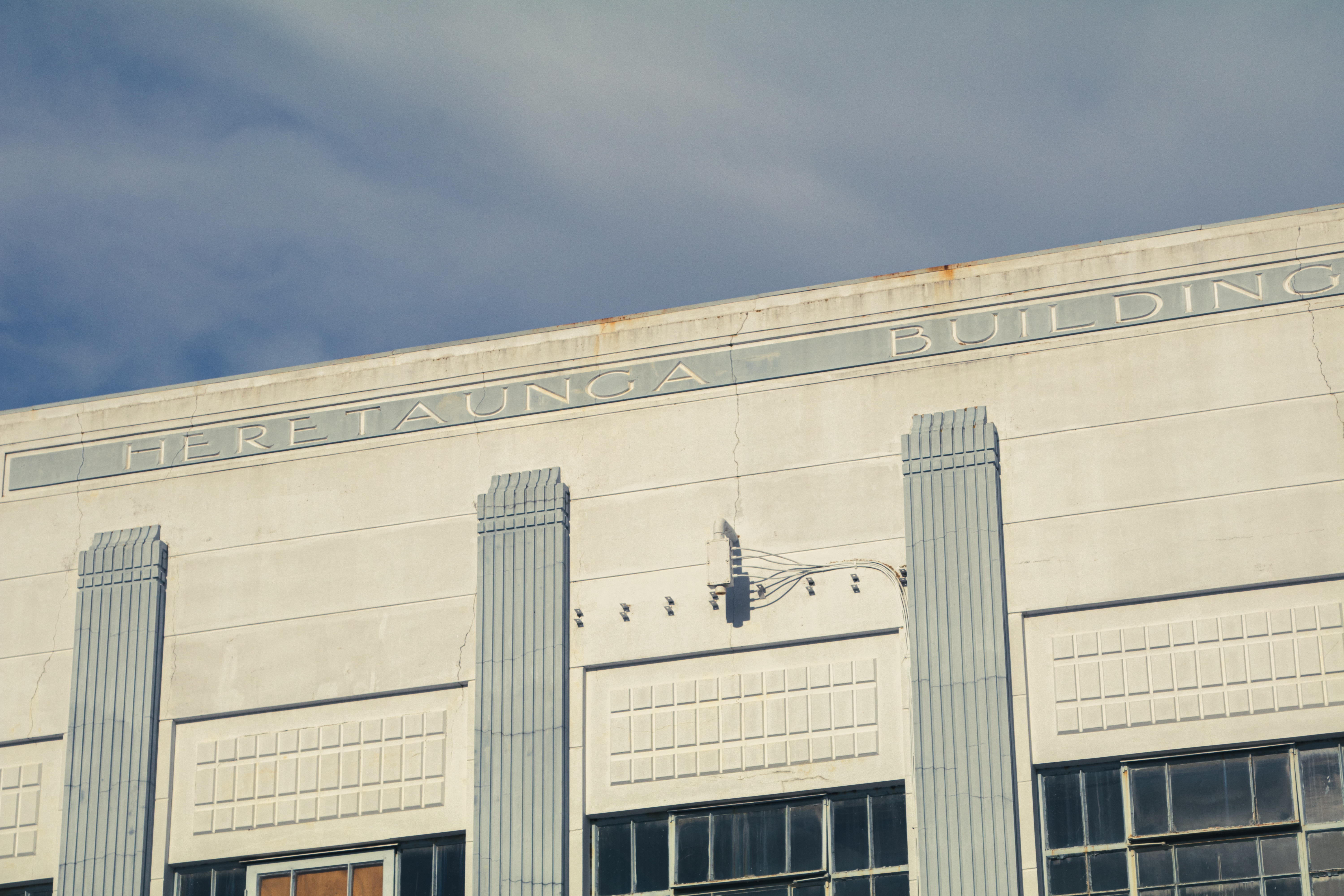
The centre of the same facade. Buildings named themselves on WestSide... not as branding, but as record. This block was featured in Home and Building magazine in 1937, held up as a model of modern shopfront design. Glass, chromium-plated metal, tiles, terrazzo. The magazine coverage is gone. The name in the plasterwork is not.
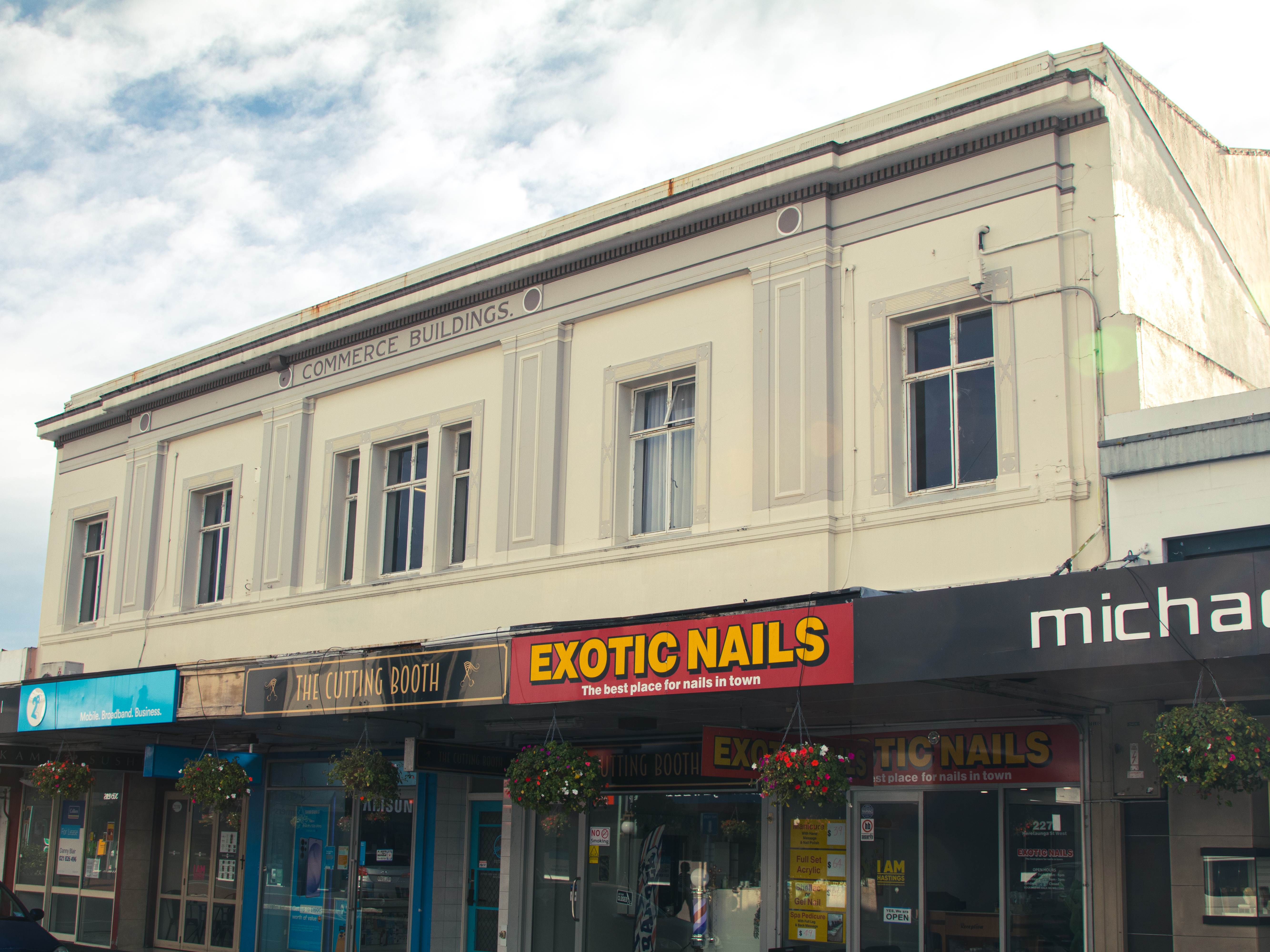
Sidney Chaplin built these five shops in 1925... the year before he designed the Hastings Clock Tower. They survived the 1931 earthquake when nearly everything else on the strip fell. He put the name in the facade and it has been there since before the earthquake, through the earthquake, and through ninety years of tenants since. In 1934, Chaplin himself had his office right here.
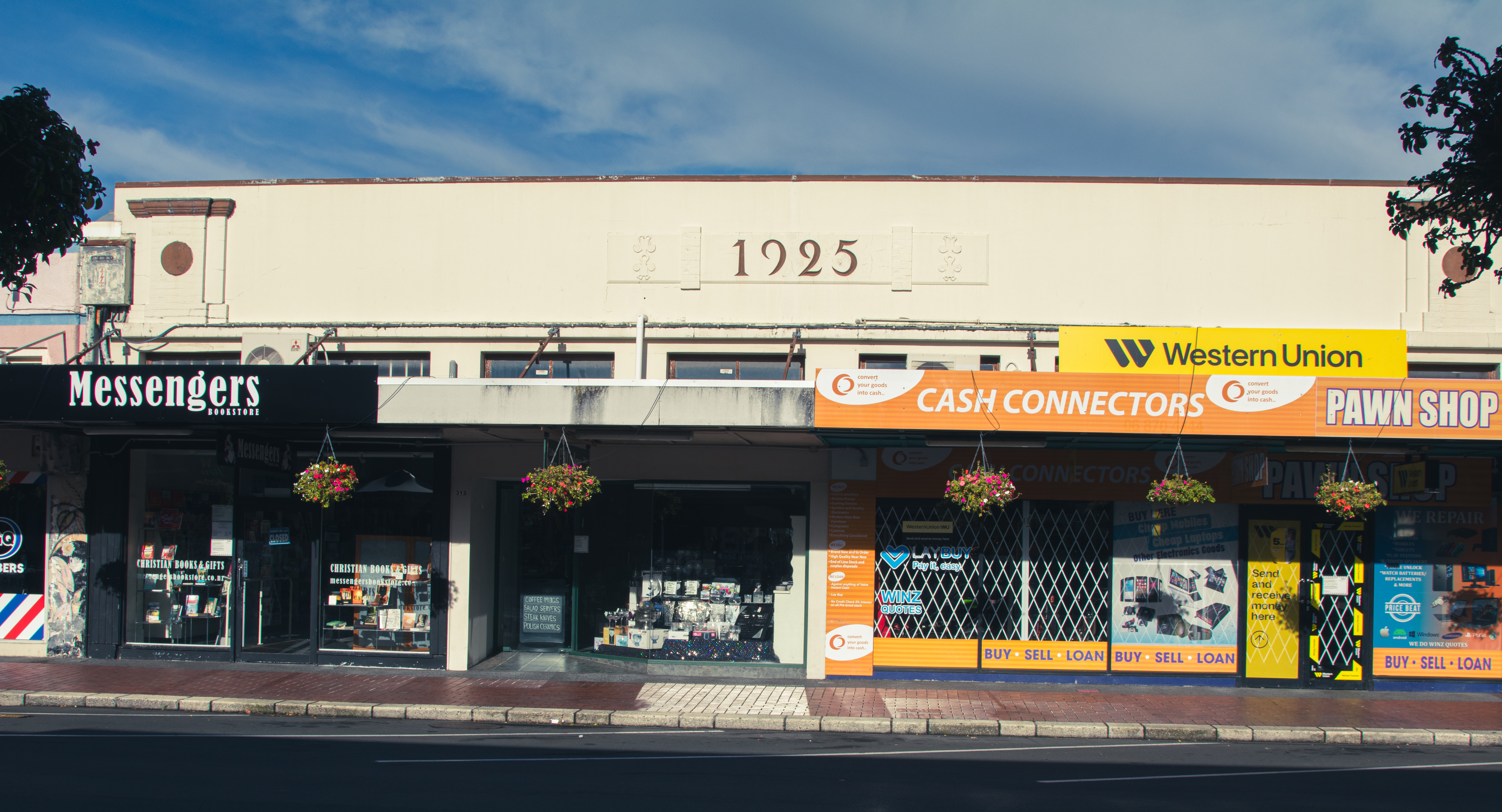
Not a name. A year. "1925" worked boldly into the central panel above the whole block... F.W. Liley, Messengers Bookstore, Cash Connectors. The Hennah family built it that year and wrote the date in. One year later, Frederick and Catherine Rush-Munro rented a shop in this building for £3-10-0 a week. Opened on Friday 26 May 1926 with seven varieties of toffee. By evening they had sold out. That was the beginning of Rush-Munro's Ice Cream Gardens. The earthquake came. They left and never came back. The year they arrived is still in the wall.
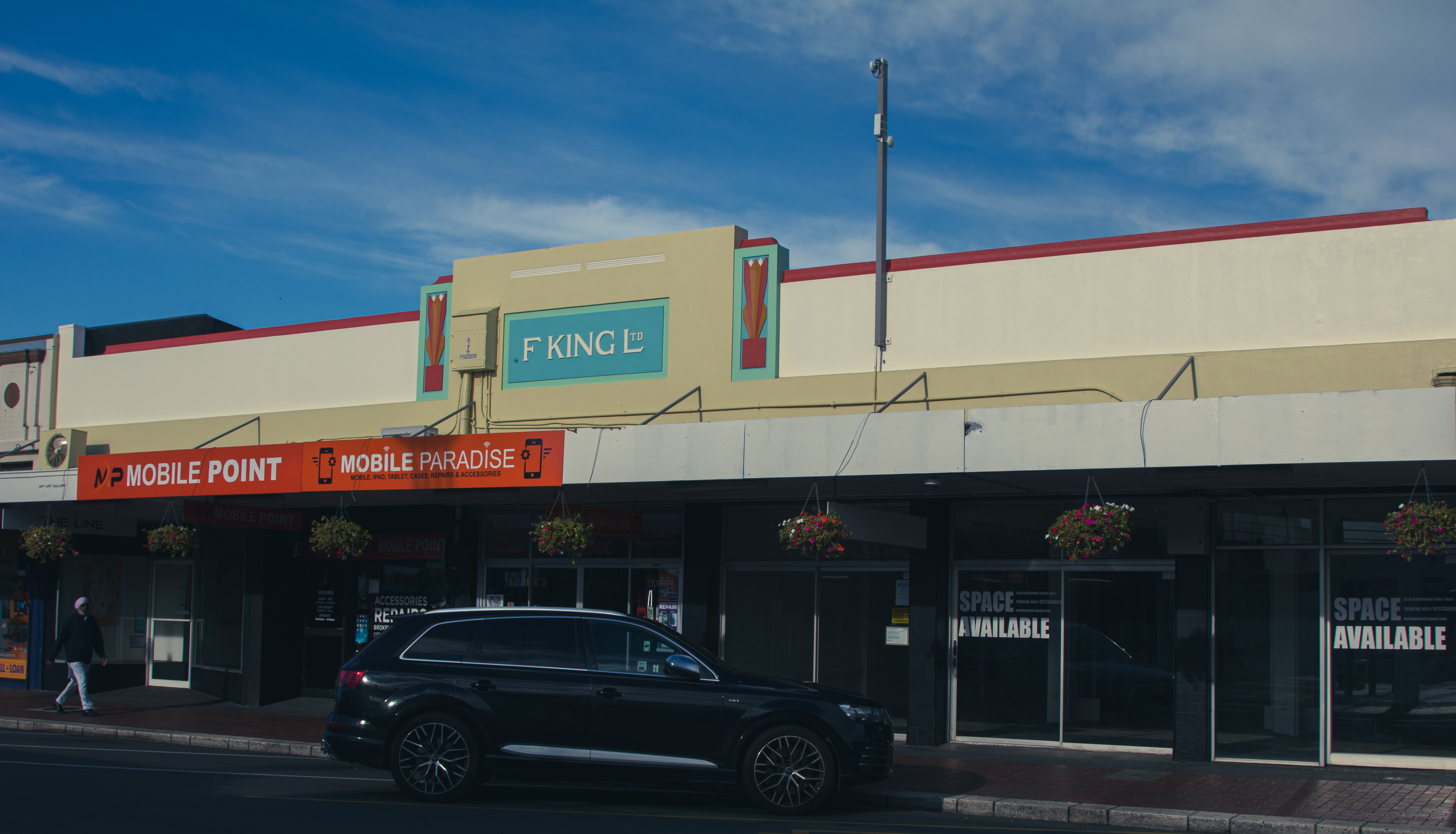
F King Ltd in the central facade panel. Tennyson Heighway ran a cycle shop here from 1925 until around 1962... nearly four decades on the same site. Zala's the Furriers were here too. Balloons & Flowers from 1994 to 2004. Budget Travel. The SPCA. And now Mobile Point, Mobile Paradise, and The Line gallery... the Southern Node of a global digital art network. The name in the concrete stayed constant while everything inside it changed.
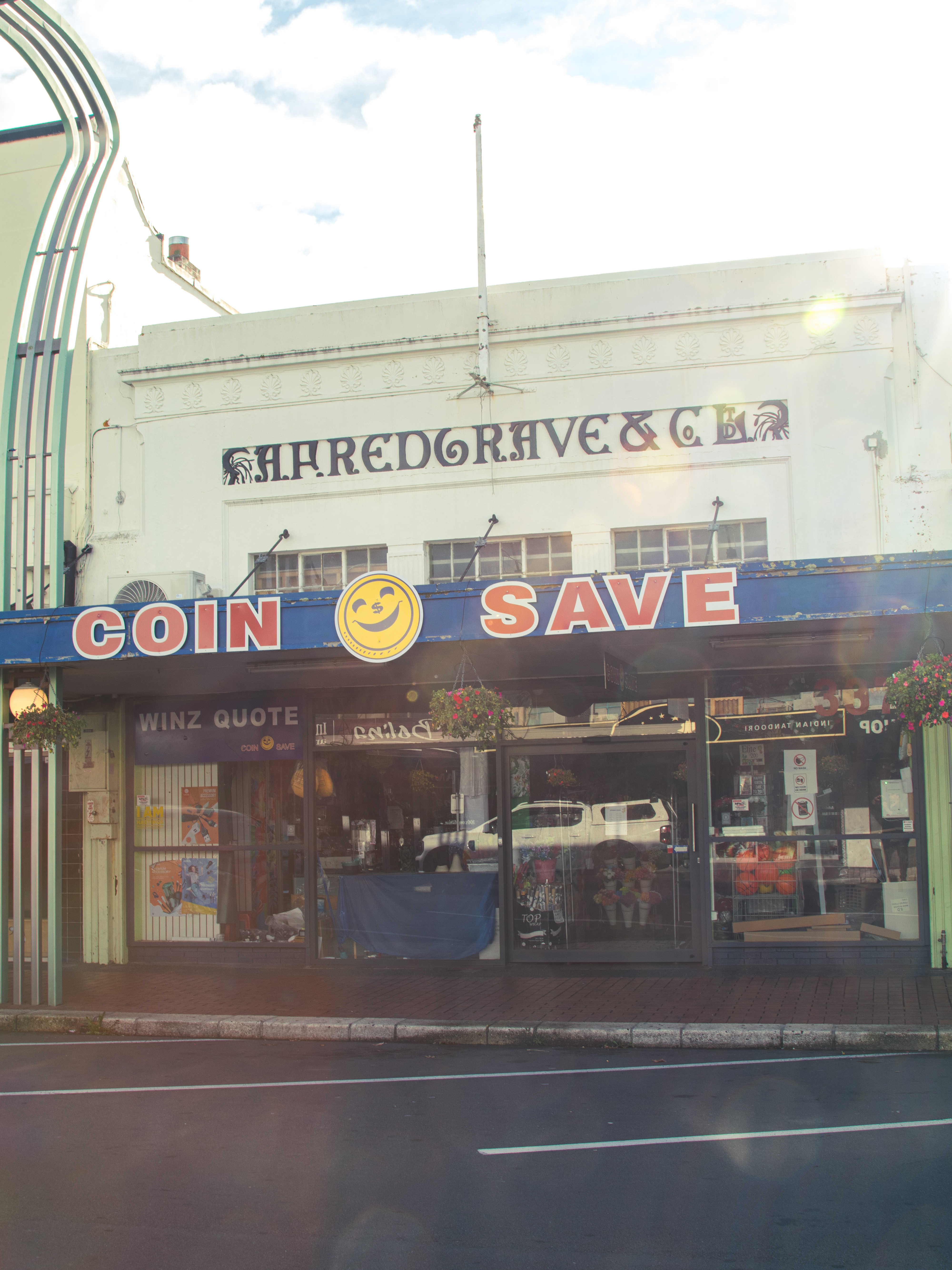
Art Nouveau relief lettering in the centre of the upper facade. The most beautiful ghost letter on the street. Arthur Redgrave started here in 1924 selling grain and seed to backyard poultry farmers and horse owners. As horses left the city and backyards changed, he evolved toward gardening. Sixty-four years. The Art Nouveau lettering Eric Phillips designed for him in 1924 is still up there above Coin Save. Same block. Different century.
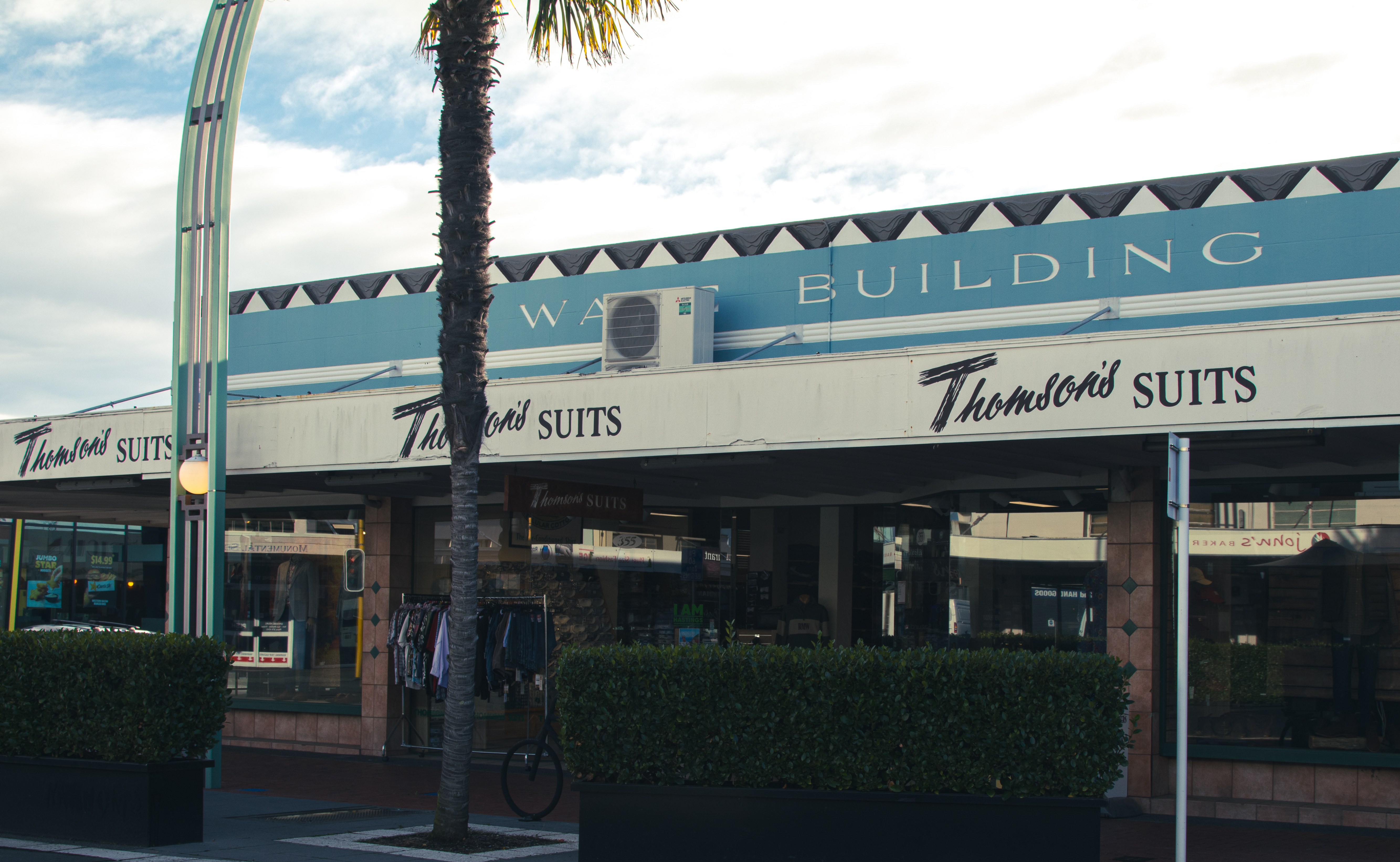
Painted in bold letters on the teal fascia band above Thomson's shopfronts... "WADE BUILDING" running the full width of the Heretaunga Street elevation. Miss Wade lost her original building on this corner in the earthquake. She used the compensation money to commission Edmund Anscombe... one of New Zealand's most significant architects, trained in the United States... to design something better. Named it after herself. Put that name in the wall. Thomson's Suits have traded from this building since 1959.
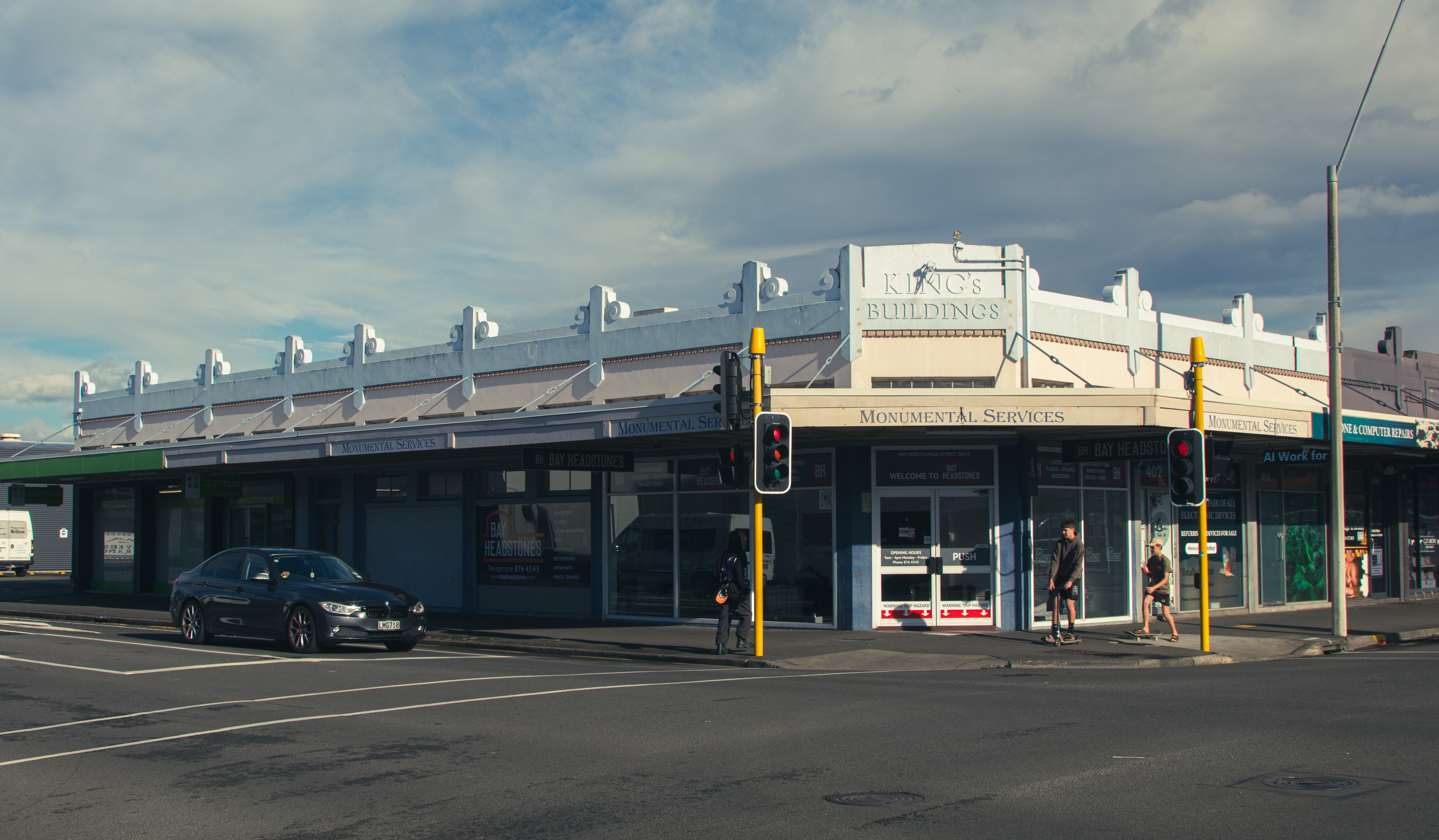
On the corner parapet at the western end of the strip. The first heritage building you reach coming into WestSide from the west... or the last one you see leaving. Francis King built the original here in 1911. The earthquake destroyed it. John Thomas Watson rebuilt it in 1932. The corner parapet still reads "King's Buildings." G.W. Grainger and Co ran a grocery on this corner for over twenty consecutive years. The name outlasted them all.
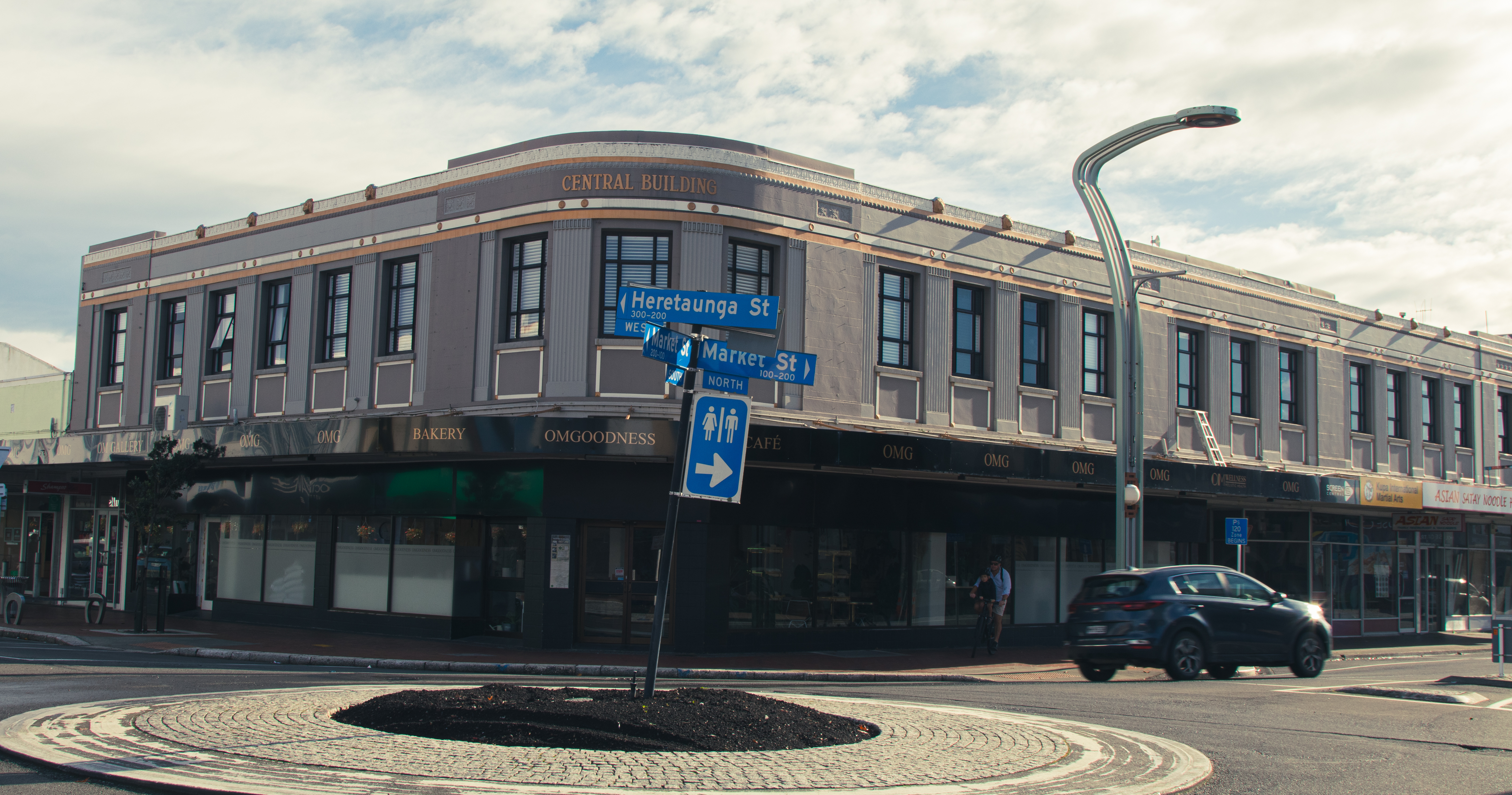
On the curved corner parapet at the Market Street roundabout... "CENTRAL BUILDING" running across the roofline in raised letters, with a handsome two-storey Art Deco facade below. Currently occupied by OMG Bakery and cafe tenants. Not yet documented in the heritage wiki. A prominent ghost letter on a prominent corner — and a new one to this list.
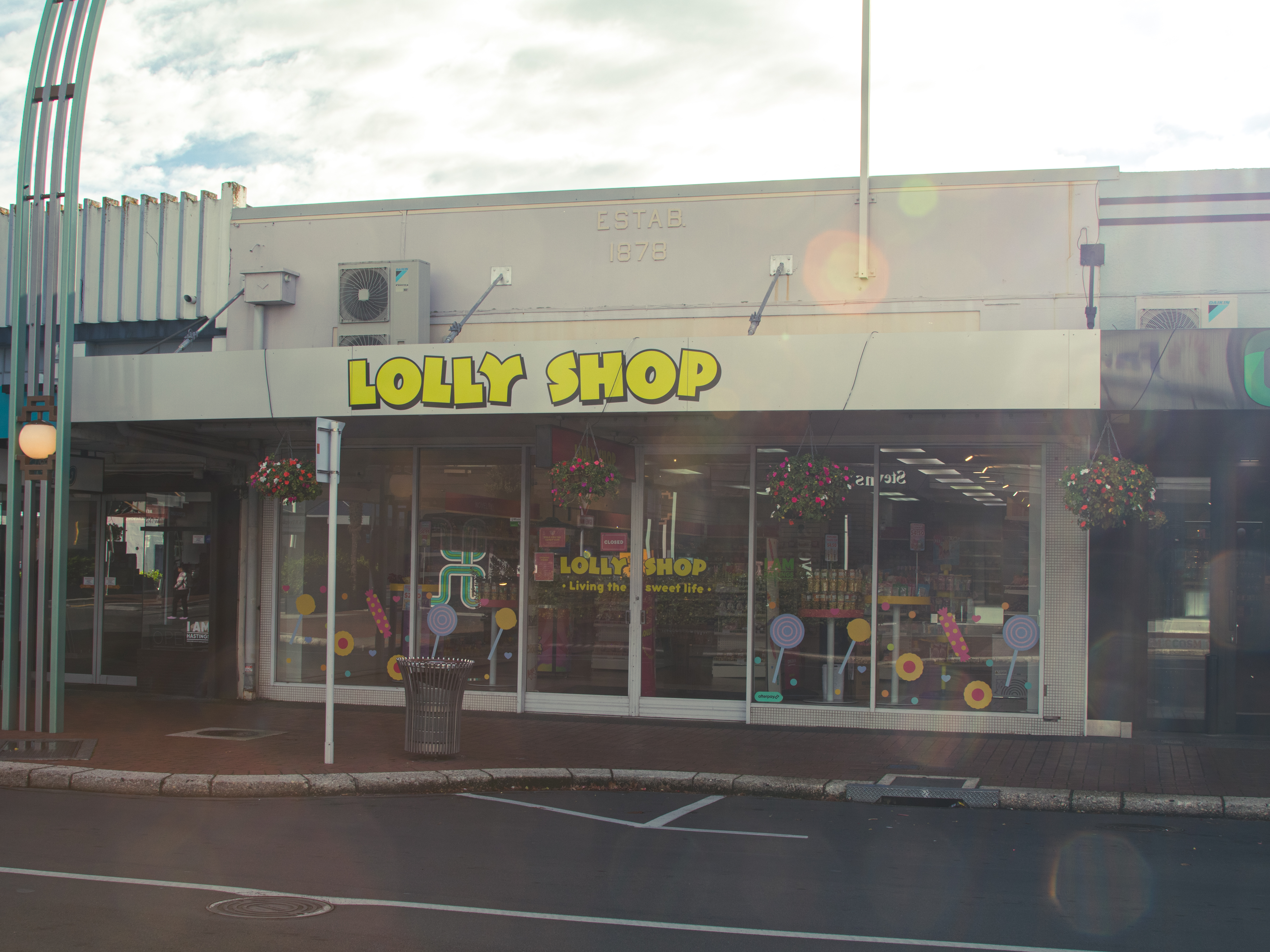
The oldest inscription on WestSide. "ESTAB. 1878" in the plasterwork above the Lolly Shop. 1878. That is six years after Hastings was named, five years after the first train arrived, twelve years before the borough was declared. Whatever was established here in 1878 survived the 1893 fire, the 1907 fire, and the 1931 earthquake. The Lolly Shop has no idea what it's standing in. Neither does anyone else yet... this one needs more research.
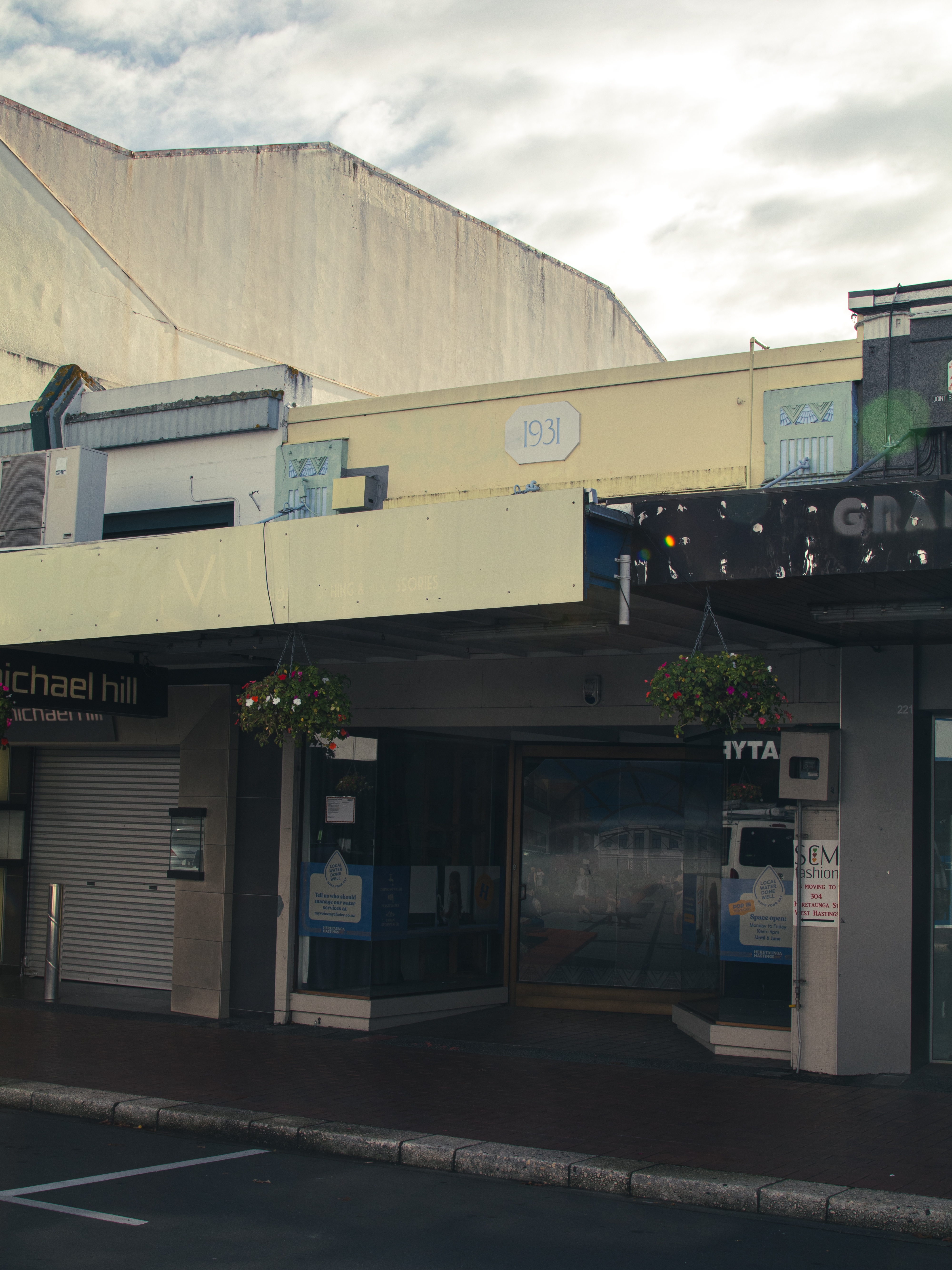
A small octagonal cartouche above a currently vacant shopfront, Michael Hill to the left, SCM Fashion signage to the right. "1931" — the year of the earthquake, the year of the rebuild. Someone built this in the same year the street fell down and dated it right there in the facade. It's either defiant or just factual. Probably both.
The Heretaunga Buildings at 210–220 HSW have a particular kind of double history. The original building was put up in 1922. Davies and Phillips redesigned it entirely in 1935, giving it new Art Deco shopfronts in glass, chrome and terrazzo. Home and Building magazine covered it the following year as a model of modern commercial design. Everything below the verandah has since been stripped out and modernised. Everything above it is exactly as it was in 1936.
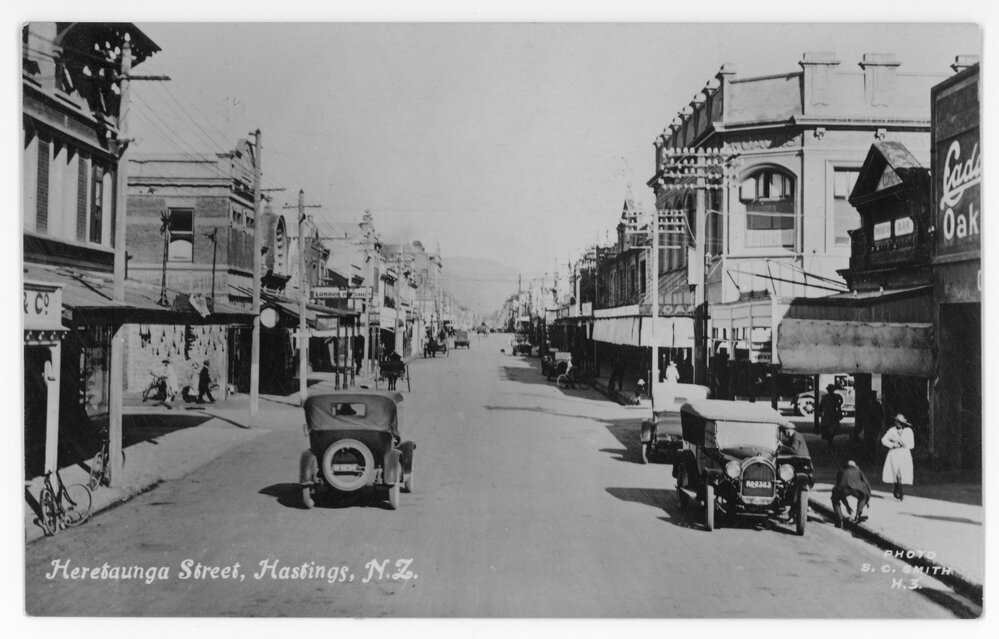
Heretaunga St, 1910s · Tanner Brothers Ltd · Hastings District Libraries · CC BY-NC-ND 4.0 · hastings.recollect.co.nz/nodes/view/10272
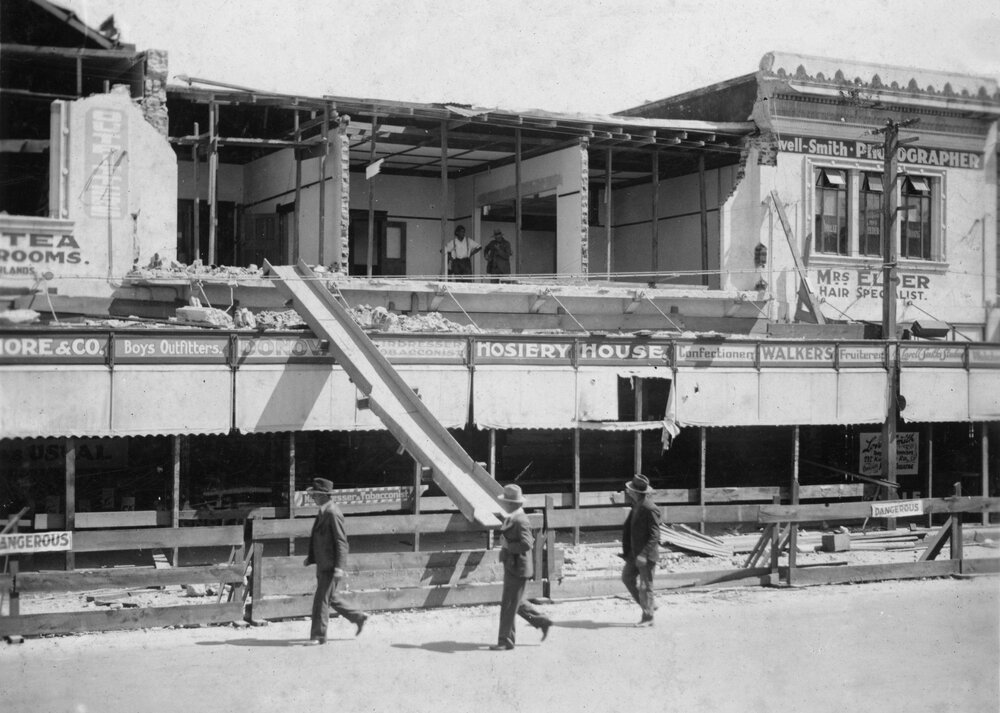
Earthquake damage, 1931 · Hastings War Memorial Library · CC BY-NC-ND 4.0 · hastings.recollect.co.nz/nodes/view/11028
That includes two names. On the left bay, above the steel windows: BLACKMORE'S. On the right bay, fading now but still traceable: H J GRIEVE. Blackmore's was a men's outfitter. Grieve's was a jeweller who also ran a shop further down at 236 HSW... that shop is still a jeweller today, under different ownership. Neither business is in the building any more. Both their names went into the 1935 rebuild as if they expected to be there forever.
Harold Davies and Eric Phillips were the most important architects on WestSide after the earthquake. Their buildings include the Heretaunga Buildings, Commercial Group 5 and 6, the Roachs' Moderne building and the Hastings War Memorial Library. The facade of nearly every block you walk past in the 200 and 300 blocks is their work. They were described at the time as the chief exponents of Art Deco in Hastings.
There is something particular about finding a business name in a building that wasn't theirs to own... Blackmore's were tenants, not landlords. But the architect put their name in the concrete anyway. At that scale, on a commercial street in 1935, that was a statement of permanence. It said: this business belongs here. It will outlast us.
It didn't. But the name did.
The most beautiful ghost letter on WestSide is at 337. Art Nouveau relief lettering, centred on the upper facade: "A F REDGRAVE & Co. Ltd." A palmette frieze. A central flagpole. Nothing below the verandah is original. Everything above it is exactly as Arthur Redgrave left it when he started here in 1924.
Redgrave was selling grain and seed to backyard poultry farmers and horse owners when he arrived on the 300 block. As the city changed around him... horses went away, backyards changed, supermarkets arrived... he evolved toward gardening. He ran the business for 64 years. When he sold it in 1988 it was still on the same site, still under the same name in the plasterwork.
The building survived the 1931 earthquake. The grain store at the rear collapsed; Redgrave applied for rehabilitation funds and rebuilt it permanently. He kept going. The Art Nouveau lettering that Eric Phillips designed for him in 1924... Phillips, who would go on to reshape the entire post-earthquake strip as part of Davies and Phillips... is still there above Coin Save today.
Redgrave's 64 years is not unusual for WestSide. Thomson's Suits has been in the Wade Building since 1959. Knit World has been in Building 5 of Commercial Group 1 since the 1980s. The Hennah family have owned sections of the 300 block since at least 1925. The ghost letters mark the extra-long ones... the businesses that stayed long enough to get written into the wall.
The ghost at 308 HSW isn't a name. It's a year. "1925" worked boldly into the central panel above F.W. Liley... still there, clean and legible, a century after the Hennah family built it. Most people walk past assuming it's decorative. It isn't. It's a timestamp.
The year matters because of what happened the year after. In 1926, a tired man named Frederick Rush Munro arrived in Hawke's Bay with £10 in his pocket and a history of failures behind him. He and his wife Catherine rented a small shop in this building for £3-10-0 a week, borrowed a coke-fired stove, bought enough materials for a few sweets, and opened on Friday 26 May 1926. Seven varieties of toffee and candy. By evening they had sold the lot.
That shop became Rush-Munro's Ice Cream Gardens. The earthquake destroyed their Heretaunga Street premises in 1931. Within 17 days they were trading again from a tent on an empty section at 704 HSW, well out of town. Their business friends called it commercial suicide to go so far from the centre. They built a pergola. They added goldfish ponds. They became a multigenerational Hawke's Bay institution. They traded at 704 for 90 years before being evicted for a petrol station in 2022.
Rush-Munro's now trades from two generic shipping containers at Albert Square Park, 102 Heretaunga Street East. The original building at 704 Heretaunga St West was demolished in December 2022 and all the multi-generational ice cream licking stories were paved over by a petrol station. The number 1925 above their first shop in 300 West is the only physical mark Rush-Munro's left on WestSide.
Frederick Rush Munro never had his name in the plasterwork. He was a tenant, not a builder. The Hennah family put their year in the wall. But if any ghost on WestSide carries someone else's story... it's that one.
At the Nelson Street corner of WestSide, the plasterwork reads WADE BUILDING. It has read that since 1932. The building behind it is one of the finest pieces of architecture on the strip... low, long, chamfering elegantly around the corner, designed by Edmund Anscombe with a fan-type parapet moulding and a reeded horizontal band mid-facade. Thomson's Suits have been inside it since 1959.
The woman who commissioned it is harder to find. Miss Mary Emma Wade owned the site before the earthquake. The earthquake destroyed her building. She used the compensation money to commission Anscombe... who had trained in the United States and would later design the NZ Centennial Exhibition buildings... to design something better. She named it after herself and put that name in the wall. She was a landlord, not a retailer. Her name isn't in any business directory. It's only in the plasterwork.
The Bistro 103 building next door... the former drive-through garage at 103-103A Nelson Street North... was also built for Miss Wade, also designed by Anscombe, and also funded by earthquake compensation. She commissioned two buildings on the same corner from the same architect in the same year. The garage was built to harmonise exactly with the main building... same imitation stone finish, same window surrounds, same parapet height. She had a vision for this corner. You can still see it.
"She used the compensation money to build something better. She named it after herself and put that name in the wall."
The photo walk turned up three ghost letters that weren't in the research at all.
The most significant is above the Lolly Shop in the 200 block: "ESTAB. 1878." Established 1878. That is the oldest inscription on WestSide... six years after Hastings was named, five years after the first train arrived. Whatever was established here in 1878 pre-dates every fire, every earthquake, every redevelopment on this strip. The building survived them all and kept the date in the wall. We don't yet know who established what. That's the next question for the wiki.
The corner of Market Street has a two-storey Art Deco building with "CENTRAL BUILDING" across the curved parapet above OMG Bakery. Not yet in the HDC heritage inventory research. Prominent position, good condition, currently unnamed in the archive.
And near Michael Hill in the 200 block, a small octagonal cartouche reads simply: "1931." The year of the earthquake. Someone built this in the ruins and dated it to the year of destruction. Defiant. Or just precise. Probably both.
Start at the railway end. Walk west. Stay on the footpath and look up above the verandah line. Ten minutes. Eleven buildings.
You've walked past all of it before without looking up. That's fine. That's what these names were built for... not to be read every day, but to be there every day. Patient. Permanent. Waiting.
It's been here. It will still be here.
The ghost letter research is drawn from the WestSide Hastings History Wiki... a growing archive of heritage inventory PDFs, street directories, photographic records and oral sources compiled for hastingscity.nz. This research has not been peer reviewed and could do with corroboration from MF History... the local authority on Hastings heritage matters... before it should be taken as settled record. Note: the heritage inventory numbers on WestSide run odd on one side of the street and even on the other, and some building numbers have shifted since the HDC surveys were conducted. The mapping of heritage building names to current tenants should be verified on the ground. If you know more, we'd like to hear it.